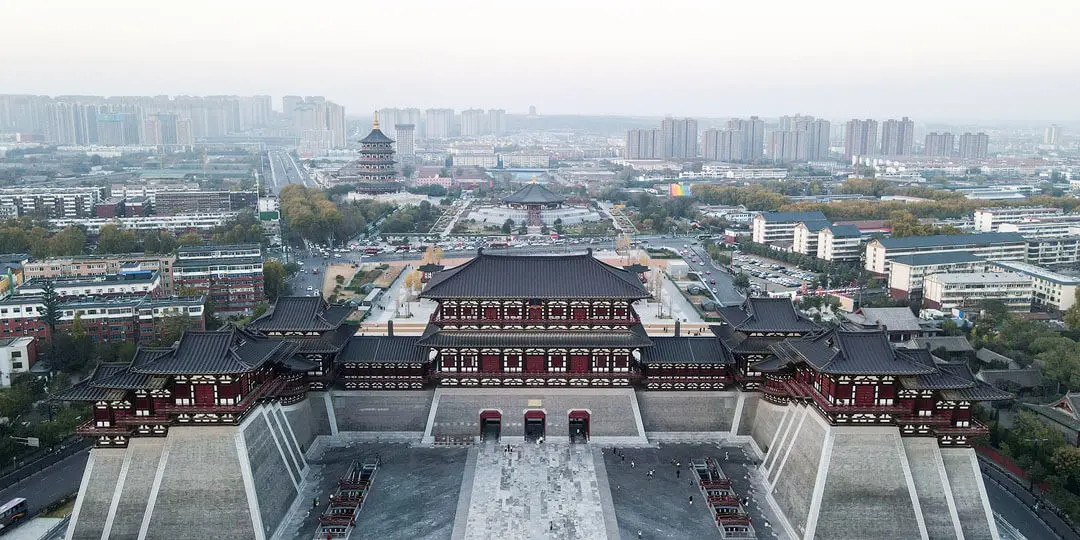
Luoyang: The Eastern Capital of Peonies and Dynastic Shifts
If Chang’an was the heart of the Tang Empire, Luoyang (洛阳) was its soul. Situated in the fertile plains of Henan Province where the Yi and Luo rivers meet, Luoyang served as the capital for thirteen dynasties, earning its reputation as the “Eastern Capital” (东都).
While Chang’an represented military grandeur and sprawling grid plan power, Luoyang was famous for its cultural refinement, grand Buddhist monuments, and extravagant spring flower festivals.
1. The Capital of Wu Zetian
During the reign of Empress Wu Zetian (China’s only female emperor), Luoyang was elevated to the primary capital of the Empire under the official name “Divine Capital” (神都).
She poured immense wealth into the city, constructing the breathtaking Longmen Grottoes (石窟) along the Yi River and building grand ritual halls inside the imperial palace. During this era, Luoyang eclipsed Chang’an as the political and economic center of East Asia.
2. The Kingdom of Peonies
Luoyang is universally synonymous with the Peony (牡丹), known in Chinese tradition as the “King of Flowers.”
During late spring, the entire city of Luoyang was transformed into a ocean of fragrant blooms. Wealthy aristocrats and common citizens alike flooded the gardens to admire rare purple, red, and white peonies. The Late Tang poet Liu Yuxi (刘禹锡) famously wrote:
Only the peony is truly a national beauty, When it blooms, it moves the whole capital of Luoyang. (唯有牡丹真国色,花开时节动京城)
3. The Literary Crossroads
Because Luoyang sat closer to the economic heartland of southern China, it served as a primary gathering place for poets, scholars, and exiled officials traveling between the capital and the provinces.
It was in Luoyang that Li Bai and Du Fu famously met for the first time in 744 AD, and it was in Luoyang that Bai Juyi spent his peaceful golden years living as a retired hermit by the Xiangshan Temple. Luoyang stands in literary memory as a softer, more reflective twin to the fierce ambition of Chang’an.